

SOLAR, EXPLAINED.
New Blog Post
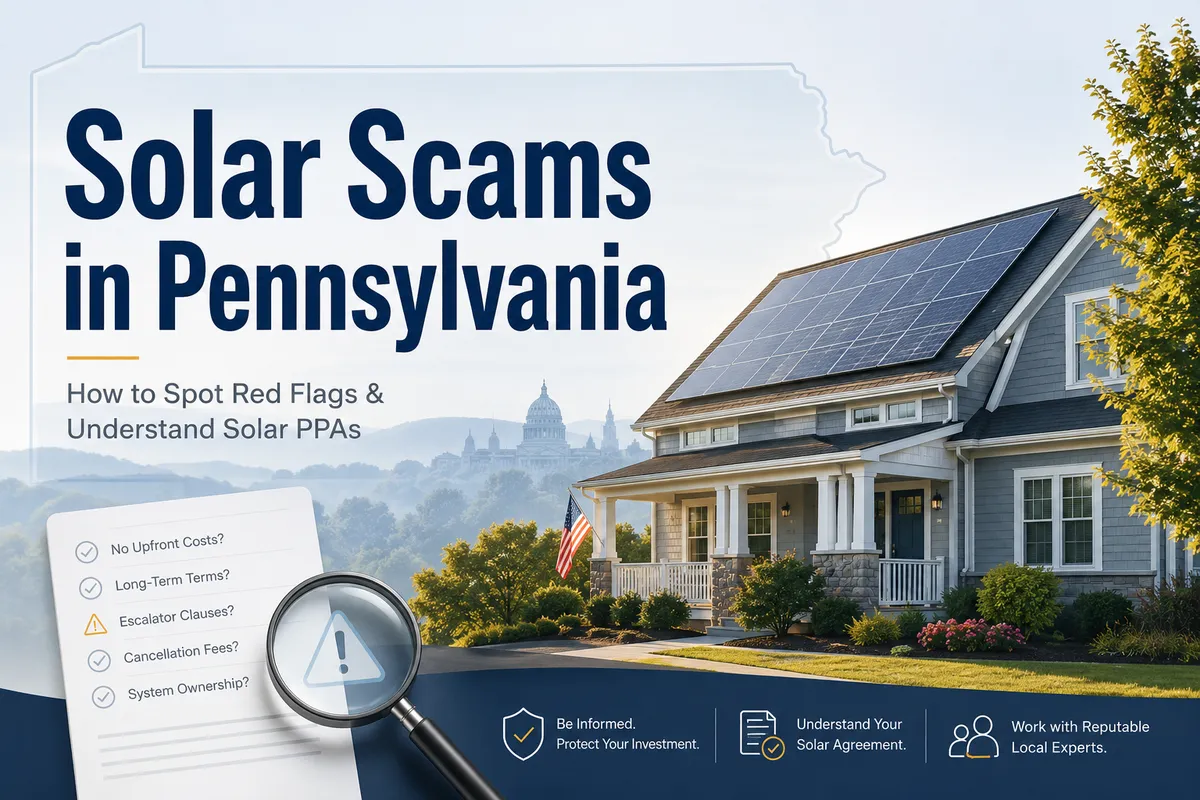
Solar Scams in Pennsylvania: How to Spot Red Flags and Understand Solar PPAs
If you live in Pittsburgh, Erie, Philadelphia, or anywhere else in Pennsylvania, chances are you've seen more solar ads, door-to-door representatives, and “energy program” offers than you did a few years ago.
And with that growth has come a lot of confusion.
Homeowners are hearing phrases like:
“This is a government program.”
“You qualify for free solar.”
“The state is paying for your panels.”
“We're working with your utility company.”
“Your electric bill is going away.”
“You need to sign today to qualify.”
Some of those statements can be misleading.
That doesn't mean solar is a scam. And it doesn't mean a solar Power Purchase Agreement, or PPA, is a scam.
A PPA can actually be a good fit for some homeowners.
The problem is that homeowners aren't always given a clear explanation of what they're signing.
At Skywalker Solar, we believe you should understand the numbers, the contract, and who owns the system before making a decision.
So here's what Pennsylvania homeowners should know.
Is Solar Really Free in Pennsylvania?
For most homeowners, no.
There is an important difference between:
“No upfront cost”
and
“Free solar.”
They're not the same thing.
With certain solar programs, including many PPAs, you may not have to purchase the equipment upfront.
Instead, a solar company or financing provider owns the system installed on your home, and you agree to purchase the electricity it produces according to the terms of the contract.
So while you may not be writing a check for $20,000, $30,000, or more to purchase a system on day one, you're still entering into an agreement involving the electricity produced by that system.
A better way to describe it is:
You may be able to go solar without purchasing the panels upfront and instead pay for the electricity the system generates.
That's very different from saying:
“The government is giving you free solar panels.”
Is a Solar PPA a Government Program?
Generally, no.
A residential solar PPA is usually a private agreement between a homeowner and a solar provider, solar financier, or third-party system owner.
The government typically isn't installing your solar panels.
Your utility company typically isn't selling you the system.
And the salesperson standing at your door is usually representing a private solar organization.
However, there is an important reason homeowners sometimes hear government programs mentioned.
Government Incentives Can Help Support Solar
Federal and state governments have created incentives and programs designed to encourage renewable energy.
Pennsylvania also has policies that can improve the economics of solar, such as net metering and renewable energy programs.
Depending on the structure of a PPA, the company that owns the solar system may receive or benefit from certain tax incentives, renewable energy credits, or other financial incentives.
That financial support can make it easier for a company to offer solar without requiring the homeowner to buy the entire system upfront.
But here's the important distinction:
Government incentives may help support the solar industry, but that does not automatically make your PPA a government program.
You're still entering into a private agreement.
That's why homeowners should be careful whenever someone says:
“This is a government solar program.”
Ask them exactly what program they're referring to.
What About Pennsylvania Solar for All?
Pennsylvania was awarded federal funding for a program known as Solar for All, designed to expand access to solar for qualifying households.
However, the status of programs like this can change.
That makes it especially important to verify any claim directly with official Pennsylvania or federal government sources before assuming a salesperson represents a government program.
If someone tells you:
“We're with Solar for All.”
“This is Pennsylvania's free solar program.”
“The government assigned us to your neighborhood.”
Ask them to show you the exact program and verify it independently.
A legitimate solar company should have no problem with you doing that.
How Does a Solar PPA Actually Work?
This is where solar sales presentations often become unnecessarily complicated.
The basic concept is fairly simple.
Without solar:
Your utility provides electricity to your house, and you pay the utility for the electricity you use.
With a solar PPA:
A third-party company installs and owns a solar system on your property.
That solar system generates electricity.
You purchase the electricity generated by the system according to the rate and terms in your agreement.
Your utility remains connected to your home and can provide electricity when solar isn't producing enough to meet your needs.
So instead of thinking:
“I'm getting free electricity.”
Think:
“I'm changing where some of my electricity comes from and what I'm paying for that electricity.”
That's a much more accurate way to understand a PPA.
Why Would a Homeowner Choose a Solar PPA?
The biggest benefit is usually avoiding the upfront cost of purchasing a solar system.
Depending on the agreement, the company that owns the system may also handle things like:
Solar equipment ownership
Monitoring
Maintenance
Repairs
Equipment warranties
Production guarantees
The exact responsibilities depend on the contract.
That's why homeowners should always ask:
“Who is responsible if something goes wrong?”
And make sure the answer is actually written into the agreement.
Is a Solar PPA a Good Deal?
Sometimes.
But not always.
It depends on the numbers.
Let's say you're currently paying your utility 15 cents per kilowatt-hour, and a solar provider offers you electricity at a lower rate.
That could potentially create savings.
But you also need to know:
Does the solar rate increase every year?
How much electricity will the system actually produce?
What utility charges will remain?
How long is the agreement?
What happens if you sell the home?
Who owns the equipment?
What happens if you need a new roof?
The starting solar rate is only one part of the equation.
What Is a Solar Escalator?
This is one of the most important parts of a PPA that homeowners should understand.
Some PPAs have a 0% escalator, meaning the price per kilowatt-hour stays the same.
Others increase the solar rate every year.
For example, your solar electricity might start at one rate and increase by a specified percentage annually.
That doesn't automatically make the agreement bad.
But you should know exactly what that increase means over the entire life of the contract.
Before signing, ask:
What is my rate in Year 1?
What is my rate in Year 10?
What is my rate in Year 20?
What is my rate during the final year of the agreement?
If your salesperson can't clearly show you those numbers, don't rush into signing.
Will Solar Completely Eliminate My Electric Bill?
Usually, no.
This is another area where homeowners can be misled.
Most solar homes in Pennsylvania remain connected to the electrical grid.
That means you could still have:
Utility connection charges
Electricity purchased from the utility
Taxes or other fees
Higher usage than your system produces
Seasonal changes in solar production
Your solar system might dramatically reduce the amount of electricity you purchase from your utility.
But saying “You'll never have an electric bill again” can create unrealistic expectations.
A trustworthy solar advisor should show you both sides:
Your projected solar cost
and
Your projected remaining utility cost
8 Red Flags Pennsylvania Homeowners Should Watch For
Whether you're considering solar in Philadelphia, Pittsburgh, Erie, or anywhere else in Pennsylvania, watch for these warning signs.
1. “The Government Is Giving You Free Solar”
Ask for the exact name of the program.
Then verify it yourself through an official government source.
2. “We're With Your Utility Company”
Ask:
“Are you actually employed by my electric utility?”
A solar company may coordinate with your utility for interconnection, but that doesn't necessarily mean they're affiliated with the utility.
3. They Won't Tell You Who Owns the Panels
If you're signing a PPA, ask:
“Who legally owns this solar system?”
You should know exactly who you're entering into an agreement with.
4. They Keep Calling It “Free Solar”
“No upfront cost” is not the same as free.
If you're purchasing electricity under a 20- or 25-year agreement, there is a financial obligation.
5. They Don't Explain the Escalator
Ask whether the electricity rate increases every year.
Then ask to see the future rates in writing.
6. They Guarantee Huge Savings Without Looking at Your Usage
A meaningful solar proposal should consider:
Your electricity consumption
Current utility rate
Roof orientation
Shading
Solar production
Contract terms
Electricity rate
Expected remaining utility costs
Nobody should be able to guarantee your savings after glancing at one electric bill for five seconds.
7. They Pressure You to Sign Immediately
Statements like:
“This price expires tonight.”
“You have to sign while I'm here.”
“The program closes today.”
should make you slow down, not speed up.
Ask for the reason behind the deadline.
If it's legitimate, they should be able to explain it.
8. They Avoid Talking About Selling Your Home
This is a big one.
Ask what happens to your PPA if you decide to sell your house.
Questions should include:
Can the agreement transfer to the buyer?
Are there credit requirements?
Can you purchase the system?
Can the agreement be prepaid?
Are there fees?
What happens if the buyer doesn't want the agreement?
Don't discover those answers three weeks before closing on your home.
Questions to Ask Before Signing a Solar PPA
Before signing anything, ask:
Who owns my solar panels?
Who is installing the system?
Who will I make payments to?
What is my starting price per kilowatt-hour?
Does that price increase annually?
What will my rate be in Years 10, 20, and 25?
How much electricity is my system expected to produce?
What percentage of my electricity usage should solar cover?
What utility bill should I still expect?
Who handles repairs?
Who monitors the system?
What happens if the system underproduces?
What warranties are included?
Who receives the solar incentives and renewable energy credits?
What happens if my roof needs replacement?
What happens if I sell the house?
Can I purchase the system later?
And finally:
“Can I take this contract and review it before signing?”
A good solar company shouldn't be afraid of that question.
Solar in Philadelphia, Pittsburgh, Erie, and Across Pennsylvania
Solar opportunities can look different depending on where you live.
A homeowner in Philadelphia may have different electricity usage, utility rates, roof characteristics, and solar production than someone in Pittsburgh or Erie.
That's why a real solar analysis should be based on your individual home.
Not just your ZIP code.
Not just your neighborhood.
And definitely not simply because somebody knocked on your door and said your house “qualified.”
Before moving forward, you should know:
Your current electricity rate
How much electricity you use annually
How much solar your roof can produce
What your solar electricity rate will be
Whether that rate increases
What you'll still owe your utility
What the long-term savings could realistically look like
Solar Isn't the Scam — Misleading Homeowners Is
Solar itself isn't a scam.
PPAs aren't automatically scams either.
There are plenty of legitimate solar companies, installers, financing providers, and representatives helping Pennsylvania homeowners reduce their electricity costs.
The real problem is when complicated financial agreements are oversimplified into phrases like:
“Free solar.”
“Government program.”
or
“Your electric bill disappears.”
Homeowners deserve a better explanation than that.
You should understand:
What you're getting.
Who owns it.
What you're paying.
How your rate changes.
What you're projected to save.
Who maintains the system.
What happens if you sell your home.
And once you understand those things, you can decide whether solar makes sense.
Sometimes it will.
Sometimes it won't.
A good solar advisor should be comfortable with either answer.
Already Have a Solar Quote? Get a Second Opinion.
If you've already received a solar proposal in Philadelphia, Pittsburgh, Erie, or anywhere in Pennsylvania, but you're not sure whether the numbers make sense, Skywalker Solar can help you review it.
No “free solar” pitch.
No pretending every homeowner should go solar.
No pressure to sign while someone's sitting at your kitchen table.
We'll help you understand:
Your existing electric costs
Your proposed solar rate
PPA escalator
Expected system production
Remaining utility costs
Equipment
Installer
Warranty coverage
Contract terms
Estimated long-term savings
Then you can decide for yourself.
Before you sign a solar agreement, know exactly what you're signing.
Contact Skywalker Solar for a straightforward solar assessment or a second opinion on a solar quote you've already received.
Frequently Asked Questions About Solar PPAs in Pennsylvania
Is solar really free in Pennsylvania?
Usually, no. Some solar arrangements may require little or no upfront payment, but that isn't the same as receiving free electricity or free equipment.
Is a solar PPA a government program?
Generally, no. A PPA is typically a private agreement involving a homeowner and a third-party solar system owner. Government incentives may help support solar economics, but that does not make the agreement itself a government program.
Is a solar PPA a scam?
No. A PPA is a legitimate way to structure a solar agreement. What matters is whether the terms are clearly explained and financially appropriate for the homeowner.
Can I get solar with no money down?
Depending on the provider, your home, your credit profile, and available programs, there may be solar options that do not require a large upfront purchase. That does not mean the solar is free.
Will I still receive an electric bill with solar?
In most cases, yes. Most solar homes remain connected to their utility and may still have connection charges or purchase electricity when solar production does not cover household usage.
Should I sign a solar agreement when a salesperson comes to my door?
You don't have to. Ask for the proposal, understand who you're doing business with, review the numbers, compare your options, and make the decision on your timeline.
Can Skywalker Solar review a quote from another company?
Yes. If you're considering a solar PPA, solar loan, or another solar proposal, getting a second opinion can help you better understand the pricing, production assumptions, escalator, equipment, and long-term costs before committing.
This article is for general educational purposes and is not legal, tax, or financial advice. Solar incentives, utility policies, programs, and contract terms can change. Always verify current information and carefully review the individual agreement you're considering.

Learn More About Your Potential Energy Savings


©Skywalker Solar 2026 All Rights Reserved.